Why identify Raspberry Pi?
When buying a Raspberry Pi, we often perceive it as a universal board. However, each unit has a unique hardware identity. In this guide, I will explain how to identify Raspberry Pi using visual and software methods. This knowledge is crucial to avoid fraud in the secondary market and ensure you receive exactly the hardware you paid for.
I will also note that Raspberry Pi is not just a popular microcomputer, but a liquid commodity that often becomes the object of fraud in the secondary market. Since the boards look identical, scammers use a substitution scheme in the warehouse or mail. Since there is also no unique serial number on the box that would be duplicated on the PCB, the owner must know the hidden methods of identifying his hardware.
In this article, I will consider each identification method in detail.
Identification Methods
Although the Raspberry Pi PCB is marked with many markings (FCC certifications, batch codes, model names), most of them are identical across millions of devices. There are only two reliable methods for accurately identifying a specific instance: visual and software.
Before checking the serial numbers, see my unboxing Raspberry Pi 5 to see the retail packaging.
Visual method: Data Matrix code
This is the only way to identify a disabled board. Every Raspberry Pi has a tiny square code in the Data Matrix format.
What makes it unique: Unlike the model name, this code contains an internal factory identifier (QA number). It is unique to each physical board that came off the assembly line. Even if two boards were released at the same time, their Data Matrix codes will be different. They contain the internal factory identifier (for example, 0000011041491320).
How to use: It is enough to have a clear photo of this code. When examining the you can scan it with your smartphone camera or simply visually compare the dot pattern. If the code or pattern is different, the board is not yours.
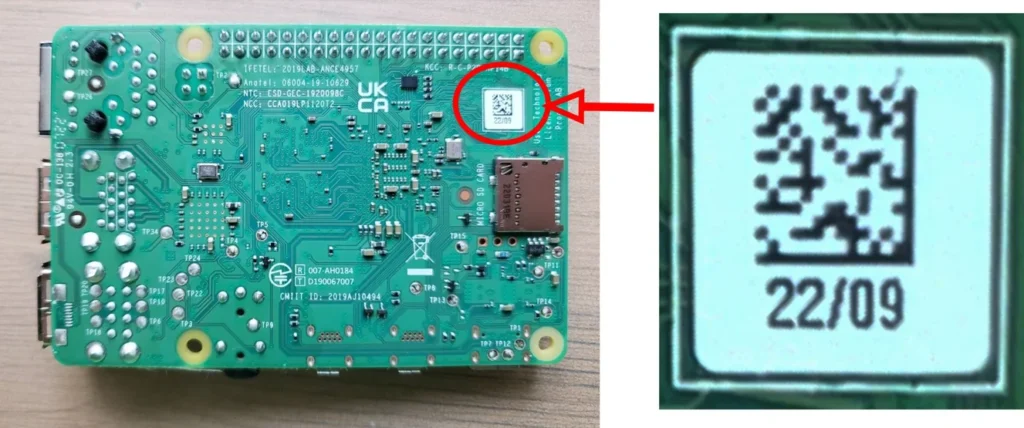
All other inscriptions that are not unique printed on the board are mainly related to certification, here is their list:
- FCC ID: 2ABCB-RPI4B – Radio module operation permit from the US Federal Communications Commission.
- IC: 20953-RPI4B – Certificate of Conformity with Radio Industry Standards of Canada.
- IFETEL: 2019LAB-ANCE4957 – Registration number of telecommunications equipment in Mexico.
- ANATEL: 06004-19-10629 – Operation permit from the Brazilian National Communications Agency.
- NTC: ESD-GEC-1920098C – Certificate of Conformity with Communications Standards for the Philippines Market.
- NCC: CCA019LP1120T2 – Low-power radio device use permit from Taiwan.
- [R] 007-AH0184 – Japanese Certificate of Conformity for Radio Frequency Equipment (GITEKI).
- [T] D190067007 – Japanese Certificate for Communication Terminal Equipment.
- CMIIT ID: 2019AJ10494 – Approval ID from the Ministry of Industry and Information Technology of China.
- KCC: R-C-P2R-RPI4B – Korean Safety and Electromagnetic Compliance Certificate of South Korea.
Pair your identified board with high-speed media from my review of Samsung NVMe SSD for Raspberry Pi 5.
Software Method: Serial Number and MAC Address
If the device can be connected to power, the software method gives the most complete information. It is a digital passport of the device, sewn into the hardware.
Serial Number: This is a unique 16-digit code of the Broadcom processor itself. It never changes, even if you reinstall the operating system or replace the SD card.
cat /proc/cpuinfo
Revision        : d04170
Serial          : 5682aaaf219cf183
Model           : Raspberry Pi 5 Model B Rev 1.0
MAC Address: A unique number for a network interface (Ethernet or Wi-Fi). It is also unique in the world.
ip link
eth0: ... link/ether d8:3a:dd:e8:5f:07 ...
wlan0: ... link/ether d8:3a:dd:e8:5f:08 ...
Peripheral identification
Add-on modules (HAT) usually do not have unique serial numbers, but have certain date codes. Mostly these codes are the same for a certain batch, but it helps to weed out boards of another batch. As with the Raspberry Pi, the POE HAT+ box also does not have a unique serial number that would be duplicated on the PCB, so such devices remain without identification.
While add-on modules are harder to track, you can still check my review of PoE M.2 HAT for Raspberry Pi 5 from Waveshare.
Conclusions
With the skills of quick identification, you can avoid unpleasant situations when reselling your Raspberry Pi. In case of substitution at the post office, the presence of the decrypted code will be your main legal evidence for appeal and refund. Remember: scammers count on your inattention, but the numbers on the PCB do not lie.